 Custom Search Back to Acid Base Links
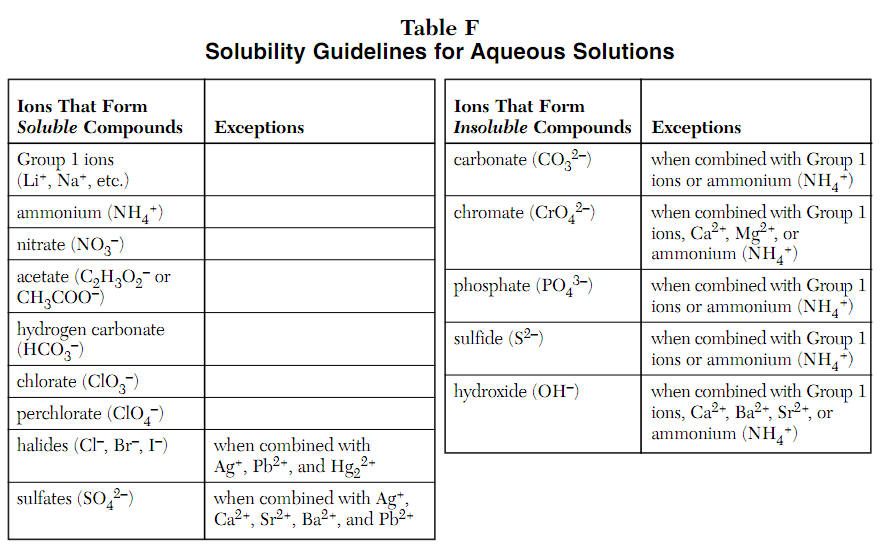
Non-electrolyte- a compound that will dissolve in water to form a solution that does NOT conduct electricity due to ions not being produced. Examples- Sugar C12H22O11 and alcohol CH3OH. Electrolyte- a compound that will dissolve in water to form a solution that will conduct electricity due to the presence of free ions. Solubility Guidelines (ions that dissolve)
Ionization-an atom or molecules that acquires a charge by either gaining or losing one or more electrons Dissociation-When an ionic compound breaks up into its ions Strong Electrolytes-Completely ionizes (or dissociates) when dissolved in water. Classes of strong electrolytes include strong acids, strong bases and soluble salts. Some other ionic solids are CaCl2, NH4Cl, KBr, CuSO4, NaCH3COO (sodium acetate), CaCO3, NaHCO3 (baking soda). Strong Acids HA(aq) → H+(aq) + A−(aq)
Back to Acid Base Links
Weak Electrolytes-an electrolyte that gives a low percentage yield of ions when dissolved in water. For example, ammonia, NH4OH, carbonic acid, H2CO3, acetic acid, CH3COOH, and most organic acids and bases are weak electrolytes. Strength of Electrolytes and Equilibrium Constants- Generally Speaking- Strong Electrolytes have very large K values. Weak electrolytes will have very small K values. Test Yourself--->CONDUCTIVITY VIRTUAL LAB<--- Past Regents Questions on Electrolytes Jan 2011-26 Which compound is an electrolyte? Jun 2010-48 Which laboratory test result can be used to determine if KCl(s) is an electrolyte? Aug 2009-27 Which substance is an electrolyte? Jan 2007-13 Which substance, when dissolved in water, forms a solution that conducts an electric current? June 2006-25 Which substance is an electrolyte? Jan 2006-38 A solid substance was tested in the laboratory. June 2005-27 Which formula represents an electrolyte? Jan 2005-25 The compound HNO3 can be described as an Jan 2004-27 Which compound is an electrolyte? June 2003-29 Which 0.1 M solution contains an electrolyte? (1) C6H12O6 (aq) (3) CH3 OH(aq) Aug 2003-9. Based on Reference Table F, which of these salts is the best electrolyte? A. sodium nitrate June 2002-23 A substance that conducts an electrical current when dissolved in water is
|